Chapter 4
How does it remember?
- The browser
- The network
- Software and languages
- The CPU
- Memory
- Arithmetic
- Logic gates
- The switch
Chapter 3 built an ALU out of gates: given two numbers it produces a result after the gate delays settle. But change the inputs and the result changes with them. The circuit has no state. It is a pure function. Everything so far has been combinational: the output depends only on the present inputs and on nothing that came before.
Memory changes that. A stored bit is a value that survives after its input disappears. Building one requires something that no combinational circuit has: feedback. The output must be wired back to an input so the circuit can hold itself in a state. This chapter builds that loop from the NOR gates of Chapter 2, then disciplines it with a clock, and finally composes flip-flops into registers and a small RAM.
4.1 The problem of memory
A combinational circuit is like a calculation on paper: you can work it out, read the answer, and then put the paper down. The answer is there only while you look at it. To store the answer you need to write it somewhere, and that writing must persist when you look away.
In digital hardware, “looking away” means removing the input. A gate’s output tracks its inputs with only a tiny propagation delay. Remove the inputs and the output drops to its default. There is nothing to hold a value in place.
Feedback creates the holding force. If a gate’s output is wired back to one of its inputs, the gate can reach a state that it reinforces. Flip the output to HIGH and the feedback path keeps the input HIGH, which keeps the output HIGH. That is the sketch of a latch. The rest of the chapter turns the sketch into hardware.
4.2 The SR latch
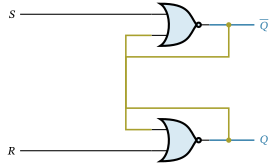
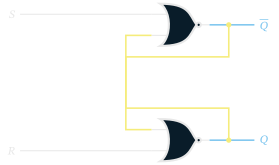
The smallest useful feedback loop is the SR latch: two NOR gates with their outputs crossed. The output of the top gate feeds an input of the bottom gate, and the output of the bottom gate feeds an input of the top gate. Figure 4.2 shows the wiring. The yellow feedback wires are the memory: they are what make the latch different from any circuit in the previous chapters.
Three inputs, three behaviours:
- S = HIGH, R = LOW: the top NOR is forced LOW, the bottom NOR sees two LOW inputs and goes HIGH. Q is set.
- S = LOW, R = HIGH: the bottom NOR is forced LOW, the top NOR goes HIGH. Q is reset.
- S = LOW, R = LOW: each gate’s output holds the other gate’s input, and both outputs are stable at their last value. The latch holds.
The hold state is the point. When S and R are both LOW the circuit sits in one of two stable states, each self-consistent. That is exactly one bit of memory.
Example 4-1. SR latch: cross-coupled NOR feedback
def sr_latch(s: int, r: int, q: int) -> int:
    """Next state of a cross-coupled NOR latch currently holding q.

    Set (s HIGH) drives q to HIGH; reset (r HIGH) drives it to LOW; with neither
    asserted the latch holds q. The two NORs are the feedback loop unrolled one
    step: qbar = nor(s, q), then q_next = nor(r, qbar)."""
    qbar = nor_(s, q)1
    return nor_(r, qbar)2
- qbar = nor_(s, q): the top gate, which combines the set input with the current output to produce the complement.
- return nor_(r, qbar): the bottom gate, combining the reset input with qbar to produce the next value of Q. The two lines unroll the feedback loop one step: they are the two NORs of the figure in sequence.
4.3 The clock and the gated D latch
The SR latch has a problem for practical use: it can be set and reset at any time, asynchronously. Building a system from dozens of such latches is difficult because signals can ripple through the network unpredictably. Real designs need a way to say: only update now, on command. That command comes from the clock, a signal that ticks between 0 and 1 at a steady rate, giving every circuit in the machine the same beat to update on.
The solution is a gated D latch. A single data input d replaces the separate S and R, and an enable input acts as a gate. While enable is HIGH the latch is transparent: Q follows d immediately. While enable is LOW the latch is opaque: Q ignores d and holds its last value.
Example 4-2. Gated D latch: transparent while enabled
def d_latch(d: int, enable: int, q: int) -> int:
    """Next state of a gated D latch. While enable is HIGH the latch is
    transparent and q follows d; while enable is LOW it holds q. That is exactly
    a multiplexer choosing between the held value and the new input."""
    return mux(enable, q, d)1
- the whole latch is a multiplexer: when enable is HIGH it selects d; when LOW it feeds the held value q back to itself. Holding is just muxing a wire back to its own input.
The gated D latch is an improvement, but it still has a subtlety. While enable is HIGH, the latch is transparent: any change in d passes straight through to Q. If enable stays HIGH for a whole clock phase, then Q can race through several values during that phase. Any downstream circuit that reads Q while enable is still HIGH may see a changing value instead of a settled one.
This is the transparency problem, and it motivates the next section.
4.4 The D flip-flop
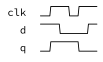
A D flip-flop solves the transparency problem by making Q change only on one instant: the rising edge of a clock signal. Two gated D latches in series produce this behaviour. The arrangement is called master-slave.
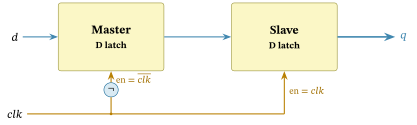
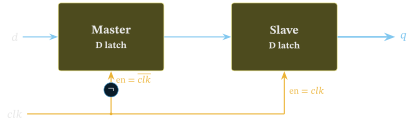
The master latch receives the inverted clock as its enable: it is transparent while the clock is LOW. The slave latch receives the clock directly: it is transparent while the clock is HIGH. At the rising edge both switch simultaneously. The master closes, locking in the last value of d before the edge. The slave opens, presenting that locked value as the new Q. Between edges neither latch changes Q: the master is opaque while the clock is HIGH, the slave opaque while it is LOW. Q moves at one moment only.
Figure 4.4 shows the timing. Notice how Q tracks the value d held at each rising edge and ignores any changes in d that happen between edges.
Example 4-3. D flip-flop: master-slave, edge-triggered
class DFlipFlop:
    """A positive-edge-triggered D flip-flop: two D latches in master-slave.

    The master is transparent while the clock is LOW, capturing the last input
    before the rising edge; the slave is transparent while the clock is HIGH,
    publishing that captured value. So q changes only on the rising edge. The
    stored bits (master, slave) are this object's state."""

    def __init__(self) -> None:
        self.master = LOW
        self.slave = LOW

    @property
    def q(self) -> int:
        """The output bit: the slave latch's stored value."""
        return self.slave

    def tick(self, d: int, clk: int) -> int:
        """Advance one step at the given clock level and data input, returning q.
        Both latches are read from the start-of-step state, so the slave sees the
        master's old value, as the hardware does."""
        new_master = d_latch(d, not_(clk), self.master)1
        new_slave = d_latch(self.master, clk, self.slave)2
        self.master, self.slave = new_master, new_slave
        return self.q
- the master latch: not_(clk) is the enable, so the master is transparent while the clock is LOW and captures the last d before the rising edge.
- the slave latch: clk is the enable, so the slave is transparent while the clock is HIGH, presenting the master’s captured value as Q.
Both latches read self.master at the start of the tick call, before either is updated. This is the key to correctness: the slave sees the old master value, exactly as the hardware does when both switches trip at the same rising edge.
4.5 Registers and RAM
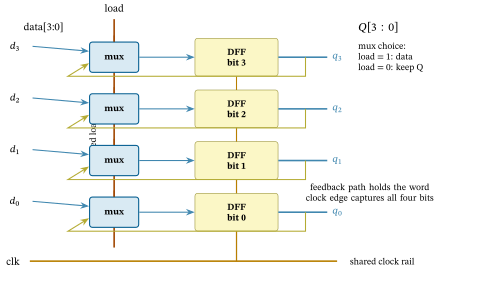
A single flip-flop stores one bit. A register stores a word by placing one flip-flop per bit and giving them a shared clock and a shared load line. When load is HIGH, the register captures the data word on the next rising edge. When load is LOW, each flip-flop feeds its own output back to its own input so the word holds.
Figure 4.5 shows the shape. The data bus fans out to every bit, but the word changes only when load is HIGH at a clock edge. The clock is what makes all four bits move together: without it, different bits could settle at different times and the register would briefly contain a mixed word.
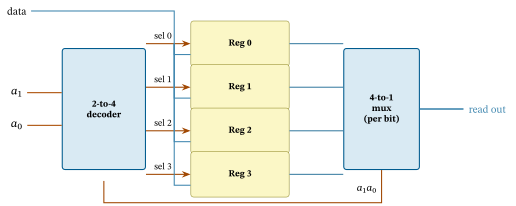
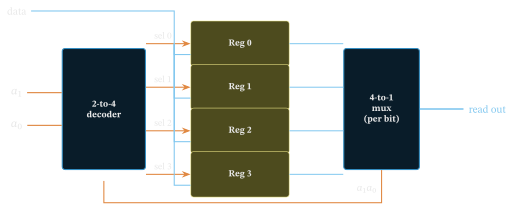
A RAM (random-access memory) adds an address. The four-word RAM here holds four registers of equal width. To write, you assert the data and address and raise the write line. To read, you supply the address and combinational logic selects the right word after its gate delays settle, without a clock edge.
The address decoder turns two address bits into four one-hot select lines: exactly one is HIGH, choosing a single register.
Example 4-4. 2-to-4 address decoder: one-hot output
def decoder(a1: int, a0: int) -> list[int]:
    """A 2-to-4 address decoder: four one-hot select lines, exactly one HIGH,
    chosen by the two address bits (a1 the high bit, a0 the low bit)."""
    return [
        and_(not_(a1), not_(a0)),1
        and_(not_(a1), a0),
        and_(a1, not_(a0)),
        and_(a1, a0),
    ]
- the first output is HIGH when both address bits are LOW: AND of two NOT gates. The four lines together cover every combination of a1 and a0 with no overlaps and no gaps.
Figure 4.6 shows the structure. The decoder on the left selects one register; on a write, only that register’s load line is asserted. On a read, a 4-to-1 mux per bit picks the addressed word combinationally.
4.6 How this scales to real RAM
The small RAM above is SRAM-like: once a bit is stored, feedback keeps it there as long as power remains. Real SRAM cells are built from transistors arranged as a tiny latch, so they are fast but physically large. That is why SRAM is used for CPU registers and caches, where speed matters more than density.
Main memory is usually DRAM. A DRAM cell stores a bit as charge on a tiny capacitor controlled by a transistor. That cell is much smaller than an SRAM latch, so a chip can hold far more bits, but the charge leaks. The memory controller must periodically refresh rows before the stored values fade. DRAM is therefore denser and cheaper, while SRAM is faster and needs no refresh.
Large memories also cannot afford one wire per word. Instead, the address is split into a row and a column. Activating a row copies many nearby cells into a row buffer; column selection then chooses the requested bytes from that open row. A second access to the same open row is a row hit and can be quick. An access to a different row must close or replace the old row, activate the new one, and wait for the sensed values to settle.
That row-and-column machine sits inside a larger memory hierarchy. CPU registers are closest and smallest, SRAM caches sit next, main DRAM is larger but slower, and storage is larger still. Bandwidth comes from moving many bits in parallel: wide buses, bursts, multiple banks, and multiple channels all let a memory system deliver more than one bit or word per internal operation.
With logic, arithmetic, and now memory in hand, the next chapter wires the three into a processor.
Exercises
- Add an enable line to the register, so it loads a new value only when enabled and holds otherwise.
- The memory holds four words. Widen it to eight. What grows, and what stays the same?